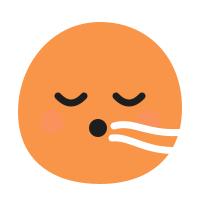
Alternate nostril breathing
One finger blocks a nostril, you breathe in through the other side, then you switch. This small gesture slows your breath and keeps your attention just busy enough to calm your mind.
- Recommended duration
- 3 to 5 minutes.
- When to use it
- To refocus between two tasks, before meditating, when you feel scattered.
Try it now
Breathe in
Follow the animation, the same as in the app.
How to do it
- Block your right nostril with your thumb and breathe in through the left, 4 seconds.
- Block the left, release the right and breathe out through the right, 4 seconds.
- Breathe in through the right, 4 seconds.
- Switch sides and breathe out through the left, 4 seconds. Start again.
What it does
- Slows and balances your breath
- Brings your attention back
- A simple gesture that anchors the exercise
Where does it come from?
Alternate nostril breathing comes from yoga, where it is called nadi shodhana in Sanskrit, often translated as “channel cleansing”. It is one of the most classic breathing practices, or pranayama, of hatha yoga. Traditionally you use your right hand: the thumb closes the right nostril, the ring finger the left one, and the index and middle fingers fold down or rest between the eyebrows.
Yoga sees it as a way to balance two energies linked to each side of the body. Even without going that far, many people simply use it to settle down before meditation or a yoga class. Some versions include breath holds; the one offered here has none, so you can do it comfortably from the very first try.
What the science says
Few studies look specifically at alternate nostril breathing, and most of them are small. We know more about the principle behind it: slowing your breath. With 4 seconds in and 4 seconds out, you drop to about 7 breaths a minute, compared with 12 to 20 at rest. A review of 15 studies (Zaccaro et al., 2018) links slow breathing to a nervous system shifted toward rest and to more calm, with less anxiety.
Alternate nostril breathing adds a gesture: switching sides takes just enough attention to stop your mind from wandering, without effort. That probably explains the sense of refocusing people describe. Let’s stay cautious: it is a wellbeing tool, not a substitute for medical advice.
Common mistakes
- Pressing too hard on your nose: a light touch is enough to close the nostril, no squeezing.
- Practicing with a blocked nose: if air cannot pass through one side, blow your nose or pick another exercise.
- Getting annoyed when you lose track: the order matters less than staying calm. If you get lost, just restart on the left.
- Raising your elbow high: your arm tires quickly. Keep it close to your body, or support it with your other hand.
- Forcing the air to feel it pass: your breath stays soft and quiet, just slower than usual.
Tips to progress
- Sit with a straight back and low shoulders, and take a few normal breaths before you begin.
- To remember the order: breathe out on the side you just opened, then breathe in on that same side before switching.
- If the hand gesture feels awkward in public, keep the same 4-count rhythm without your fingers: it becomes plain slow breathing, much like coherent breathing.
- Before meditating, 3 minutes of alternate nostril breathing helps you settle; then move on to breath counting.
- When 4 counts feel easy, stretch to 5 or 6, still without forcing.
In the app, this technique is guided by a voice, its own animation and ambient sounds. To create your own rhythm, use BreathLab.
Alternate nostril breathing: frequently asked questions
How do you do alternate nostril breathing?
Close your right nostril with your thumb and breathe in through the left, then close the left and breathe out through the right. Breathe in through the right, switch, breathe out through the left. Each step lasts 4 seconds, for 3 to 5 minutes.
What if my nose is blocked?
Do not force it. Blow your nose, and if one side stays blocked, save the exercise for later. In the meantime, coherent breathing or prolonged exhalation work without closing your nostrils.
What are the benefits of alternate nostril breathing?
It slows your breath and keeps your attention busy, which helps you refocus when you feel scattered. Research on this exact technique is limited: the effects described come mostly from slow breathing in general.
Which fingers do you use for nadi shodhana?
Traditionally, the right thumb closes the right nostril and the right ring finger the left. You can also use your thumb and index finger: whatever feels most comfortable is the right choice.
Can I do alternate nostril breathing at night?
Yes, it is calm and has no breath hold. If your goal is to fall asleep, 4-7-8 breathing, with its long exhale, is a better fit. If you have a breathing or sinus condition, ask your doctor for advice.
Other techniques

Box breathing
Get your focus back
4 · 4 · 4 · 4
4-7-8 breathing
Fall asleep faster
4 · 7 · 8

Abdominal breathing
Release tension
4 · 6

Dynamic breathing
Recharge
30 × 1 · 1, then 15
Mantra breathing
Quiet racing thoughts
4 · 6
Staircase breathing
Lengthen your breath step by step
2 to 7 s
Prolonged exhalation
Bring tension down
4 · 8
Coherent breathing
Find your balance
6 · 6
Physiological sigh
Defuse a crisis
3 · 1 · 6
NewGong breathing
Breathe to the sound, no voice
5 · 7
NewBee breath
Calm down by humming
4 · 8
NewOcean breath
Breathe like the waves
5 · 7
NewBreath counting
Anchor your attention
4 · 6
moopy flow is out on iPhone
7 day free trial, no commitment.
On Android? Try the app now and get 3 months of Premium free